


The COVID-19 pandemic consumed our lives while it was happening. After it was over, we seemed to collectively agree that we’d like to forget all about it.
This isn’t necessarily a good thing, according to Martha Maier, pastor emeritus of St. Andrew Lutheran Church in Orchards.
“I think people need a way to begin processing the pandemic,” Maier said.
Maier decided to create a space where anyone is welcome to spend time reflecting on what they lost during the pandemic, what they gained and how it changed them.
She looked for liturgical resources to help plan such a service, but said she couldn’t find any church that had done anything like this — though Great Britain and the World Health Organization both observed COVID days of remembrance. According to nationaltoday. com, March 11 has been designated as National COVID-19 Day. It’s given the same weight as National Johnny Appleseed Day and National Oatmeal Nut Waffles Day, both of which also fall on March 11.
“I discovered that no one really, in our country at least, is commemorating or remembering the pandemic,” Maier said.
Since Maier couldn’t find any liturgies for the occasion, she said she used AI to create her own “Litany of Reflection, Support and Hope for the Sixth Anniversary of the COVID 19 Pandemic.” It acknowledges that people are still deeply affected by the deaths of friends and family, loss of employment or the physical effects of longterm COVID: “Six years later,” the litany reads, “we recognize that healing is not linear, and grief does not follow a schedule.”
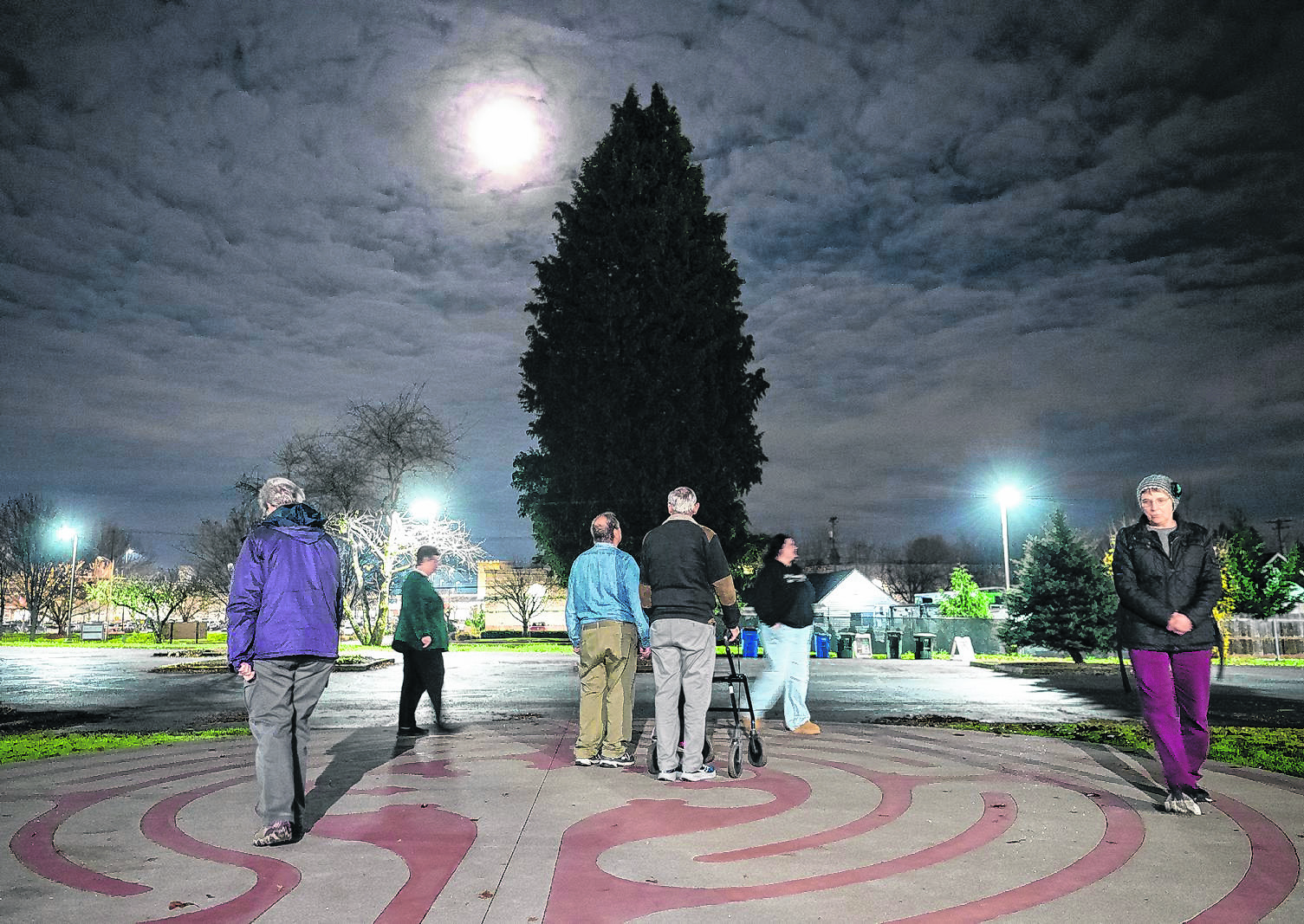
Maier will conduct two services of healing at 8:30 and 11 a.m. March 15, with candlelighting, prayer for those who want it and the chance to walk around either a small indoor labyrinth or an outdoor labyrinth. Alternately, people can attend (or skip) the service and come back at 2 p.m. for a more focused labyrinth walk with guides, thought-provoking prompts and activities such as journaling or writing the names of loved ones on paper hearts that will later be strung across the sanctuary.
St. Andrew Lutheran Church has been using labyrinths for reflection and meditation for just over 15 years, Maier said. Congregants created their own indoor canvas labyrinth in 2010 and construction on the church’s outdoor labyrinth was completed in 2023. Last year, the church also received a large indoor labyrinth from Vancouver labyrinth scholar Eunice Schroeder. The indoor labyrinths are rolled up and stored when not in use, but the outdoor labyrinth is open to anyone 24 hours a day.
“It’s a meditative walk and like any contemplative spiritual practice, every time you do it, it’s a little different,” Maier said.
Maier said it takes about 15 minutes to walk into the center and back out again, depending on pacing. Some people might want to take a little more time or focus on a few different things, she said, while others might comfortably follow the labyrinth’s route in 10 minutes.
Maier said she’ll provide a list of questions for people to think about as they’re walking, including “What do you remember?” “What are you grieving?” “What was hard?” and “What are you grateful for?”
Labyrinth walkers can also take “kindness rocks,” Maier said, decorate them and leave them around their neighborhood as a way to encourage others. There will be places to journal and a time to share personal stories about the pandemic’s impact.
“If you don’t grieve something, if you don’t reflect on it, you stuff it inside instead,” Maier said. “It’s leading to the polarization of our country right now, or at least it’s one of the things.”
On the upside, Maier said the pandemic taught her how to use technology to connect with people in ways she hadn’t, like conducting worship services online or meeting with people over Zoom. But Maier also worried about her son, now 34, who has Williams syndrome, a rare genetic disorder. The lack of socialization was acutely challenging for him, she said, as it was for so many of us.
Maier recently discussed the need to acknowledge grief on “The Starry-Eyed Podcast,” produced by the Williams Syndrome Association. The episode, aired on Feb. 10, was called “It’s Okay to Not Be Okay.”
“We always think that grief gets smaller with time, but it’s not that grief gets smaller, it’s that life gets larger,” Maier said, referring to author and counselor Lois Tonkin’s 1996 model for understanding grief. “It’s not just COVID. As a country, we need to be learning how to deal with grief in general.”
Monika Spykerman: 360-735-4556; monika. spykerman@columbian.com
IF YOU GO
What: COVID Day of Remembrance labyrinth walk and worship services
When: Labyrinth walk: 2-4 p.m. March 15 with story-sharing from 3-4 p.m. Worship services: 8:30 and 11 a.m., with candle-lighting and healing prayer stations
Where: St. Andrew Lutheran Church, 5607 N.E. Gher Road, Vancouver
Information: salcvan.org/ labyrinth