


Rep. Gluesenkamp Perez’s Votes
Rep. Marie Gluesenkamp Perez, D-Skamania, was the second most likely member of Congress to vote against her party in 2025.
An article published Jan. 2 on Fox News ranked the top 10 “House mavericks” who “defied their own parties more than anyone else” last year.
Perez, the article noted, voted against Democrats 77 times in 2025 and was “the second most likely member to buck the party trend on any given vote in the 119th Congress.”
Voters who delivered wins to Perez in 2022 and 2024 may not be too surprised by the 3rd Congressional District representative’s voting record.
In an emailed statement Tuesday, Perez said she has always been clear with her constituents that she would not bend to party politics on Capitol Hill.
“I’ve always promised Southwest Washington I’d do things differently than a typical politician,” Perez said. “I’m confident that most of our neighbors want a representative that would rather deliver on our community’s priorities than pass a partisan purity test, and that’s how I’m doing the work of serving as our member of Congress.”
Vote ‘unforgivable’
Perez has, however, experienced pushback from 3rd Congressional District constituents over her voting record.
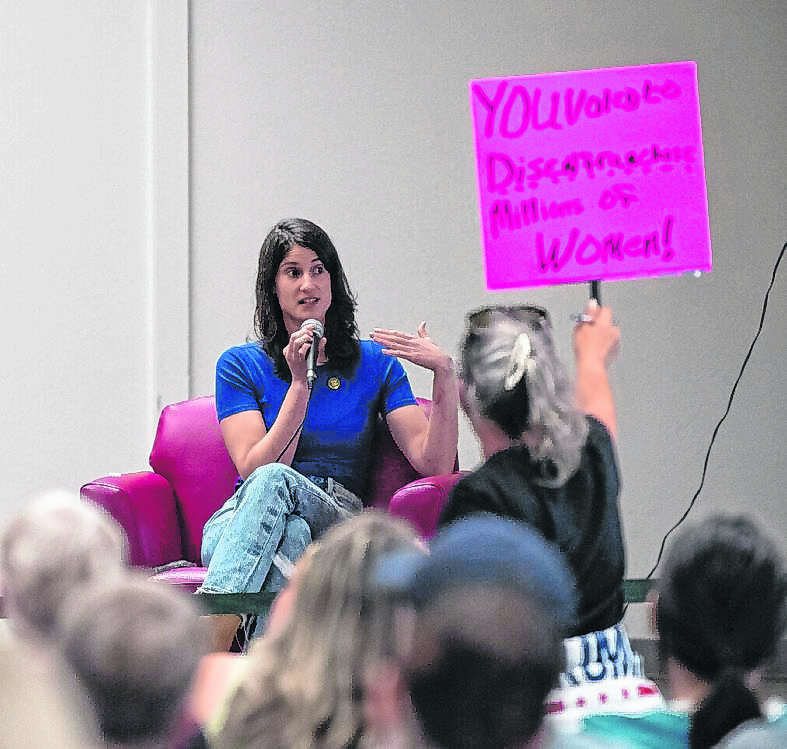
At town halls in Longview, Vancouver and Battle Ground in 2025, the 37-year-old cochair of the Blue Dog Coalition of centrist lawmakers faced scores of unhappy constituents, including many who said they had voted for and even campaigned for her.
Many who spoke against Perez during an April 24 Vancouver town hall voiced objections to her vote on the Republican-backed SAVE Act requiring proof of citizenship to vote in federal elections. The National Women’s Law Center has said the act will “make it harder for millions of Americans with the legal right to vote to do so,” especially women who may have changed their names after marriage.
Perez was one of four Democrats to vote in favor of the SAVE Act, which passed 220-208 in the House on April 10. Perez explained her vote the same day, and said she does not support noncitizens voting in American elections.
“Voting in our nation’s elections is a sacred right belonging only to American citizens, and my vote for the SAVE Act reflects that principle,” she said then.
Her explanation did not satisfy the voters who showed up at her Vancouver town hall later that month, including LaDonna Kirkpatrick, chair of the 18th Legislative District Democrats.
“The SAVE Act vote was unforgivable,” Kirkpatrick said.
Vancouver resident Bob Stevens, 75, said he supported Perez during her past two elections but has been disappointed since.
“I felt she understood the argument about the rural-urban divide,” Stevens said. “But I feel like she’s really dropped the baton on issues she originally advocated for and had actually established some credibility.”
Stevens said he has contacted Perez’s office several times and has requested that his representative come to downtown Vancouver to speak about her position on women’s rights, climate change, protecting voting rights, U.S. Immigration and Customs Enforcement actions against citizens, preserving the U.S. postal system and other issues.
“I wasn’t really satisfied with the answers coming from her office,” Stevens said.
Thoughts on ICE
Recent ICE actions in Vancouver have physically harmed at least two people and caused fear to ripple through the city’s diverse Fourth Plain Boulevard business district. In emailed responses to The Columbian’s questions, Perez said she believes ICE “provides a necessary service to our country,” but that she is worried the federal immigration enforcement agency’s tactics, including “the deployment of agents into our communities, along with the posture and bravado of this administration” is “making local law enforcement’s job more challenging and eroding public confidence in the agency’s legitimacy.”
Concerns about ICE actions have dominated recent Vancouver City Council town halls and other community gatherings.
At a Vancouver City Council meeting Monday, Councilor Erik Paulsen said he attended a recent meeting for the Vancouver chapter of the progressive political group Indivisible.
The meeting fell the day after an ICE agent opened fire into a Minneapolis woman’s vehicle, killing Renee Good, a 37-year-old mother of three. Paulsen said the meeting was packed, and most of the attendees were focused on ICE actions.
“They felt vulnerable, even if police are there to witness it,” Paulsen said.
Perez said she’s wary of cracking down on tactics used by ICE because they’re also used by other law enforcement agencies.
“For example, some crime victims would be further endangered if my sheriffs were prevented from using unmarked vehicles when soliciting statements,” she said.
Stevens, the Vancouver resident who backed Perez in the past, said he wishes the representative would take a page from another Democratic congresswoman from the Pacific Northwest: Rep. Maxine Dexter, who represents Oregon’s 3rd Congressional District.
Dexter has been an outspoken critic of ICE and its impacts in Oregon and throughout the nation.
On Jan. 8, after ICE agents allegedly shot two people near Mall 205 in Southeast Portland, Dexter released a statement saying ICE “has done nothing but inject terror, chaos and cruelty into our communities” and that “Trump’s immigration machine is using violence to control our communities — straight out of the authoritarian playbook.”
Dexter said ICE “must immediately end all active operations in Portland” and promised to share updates with her constituents as more information became available.
“I am demanding full accountability and transparency,” Dexter said. “We must allow our local law enforcement to do its work. There must be a comprehensive investigation without Trump’s interference.”
That’s the type of rhetoric Stevens said he’s longing to hear from his own Democratic representative.
In spite of what Perez has heard from unhappy constituents, the representative seems confident her refusal to support Democrats on every issue is what best serves her district.
“Our system doesn’t work when lawmakers’ gut instinct is to defer to what the loudest partisan voices want,” Perez said in her emailed statement. “Democracy is not a consumer good that you buy off the shelf at a chain store. It demands an ethic of care, and a willingness to engage with those we may not fully see eye to eye with.”
Kelly Moyer: 360-735-4674; kelly. moyer@columbian.com